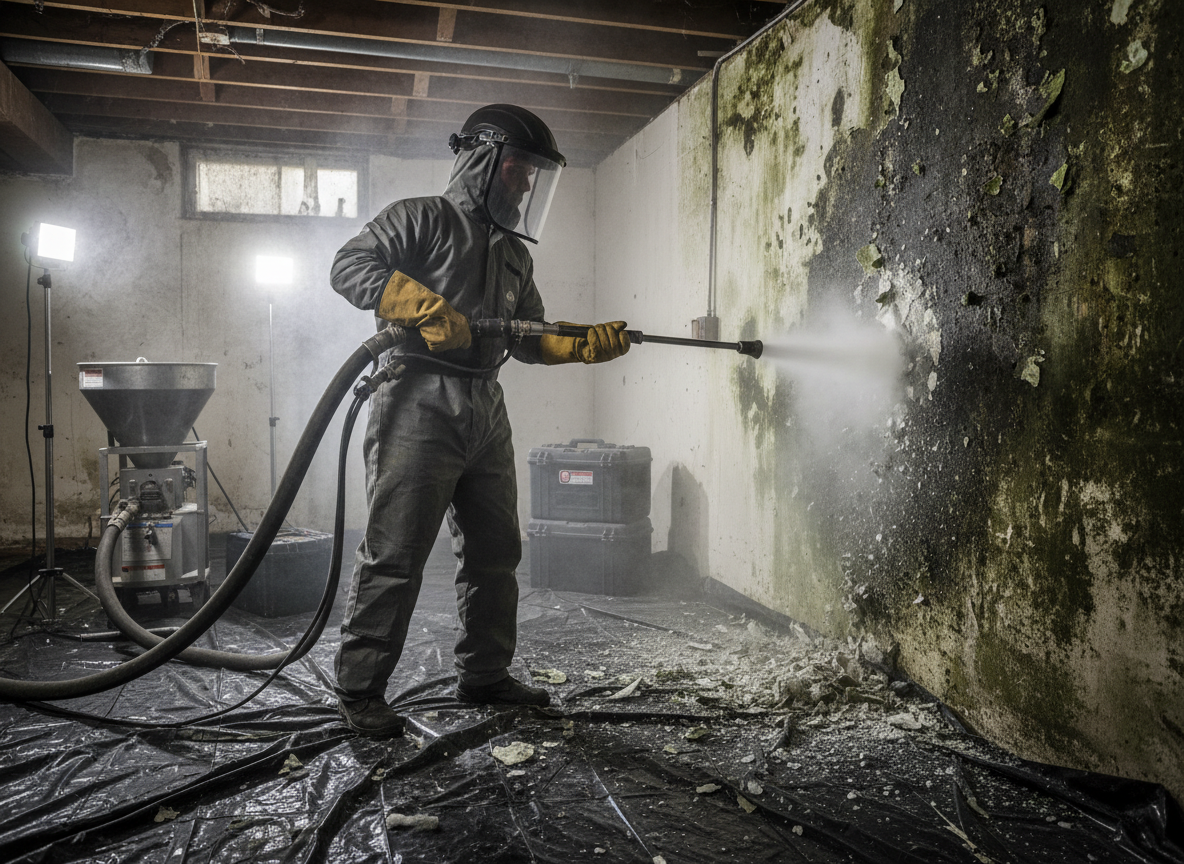
Dry ice blasting uses solid carbon dioxide pellets accelerated at high velocity to lift mold colonies from porous materials common in Reseda's 1950s-1970s housing stock. The process sublimates on contact, leaving no residue and avoiding the moisture that can restart growth during the area's hot dry summers. Technicians contain the work area with plastic sheeting and negative air machines to prevent spores from migrating into living spaces near Reseda Park or Westfield Topanga.
In Los Angeles County homes, especially those close to Lake Balboa or along Victory Boulevard, hidden mold often appears behind bathroom tile or under kitchen cabinets after minor plumbing leaks. Dry ice blasting reaches these tight cavities without removing drywall when the infestation stays surface-level. Crews monitor humidity levels throughout because the Mediterranean climate keeps outdoor air dry most of the year yet indoor condensation still forms on cooler walls during rare winter rains.
Operators wear full PPE and follow EPA guidelines for containment when working in multi-unit buildings or near shared walls in Reseda. The method works well on concrete foundations and attic sheathing but requires pre-testing to confirm the mold has not penetrated deeply into insulation. After blasting, surfaces are HEPA-vacuumed and the area is rechecked with moisture meters before clearance.
Technician insight
In Reseda, the thing that catches most people out with dry ice blasting mold is irrigation leaks from older sprinkler lines around Reseda Park that keep soil damp against stucco foundations even during the long dry summers; homeowners often miss these until the mold returns inside the wall cavity.
Hidden Mold Behind Kitchen Cabinets
Problem: recurring musty smell in a 1960s Reseda home near Van Nuys Boulevard. What we found: surface mold on plywood backing caused by a slow leak from the adjacent bathroom. What we did: contained the kitchen, used dry ice blasting on the exposed wood, and dried the cavity. Outcome: odor eliminated and no regrowth after three weeks of monitoring.
How it works
- 1
Initial Assessment
Technician inspects affected areas in the Reseda property, identifies moisture sources, and maps visible mold growth.
- 2
Containment Setup
Plastic barriers and negative air filtration isolate the work zone to keep spores from spreading to unaffected rooms.
- 3
Dry Ice Blasting
Pellets are applied at controlled pressure to lift mold from wood, concrete, and stucco without abrasion or added moisture.
- 4
Final Cleaning and Verification
HEPA vacuuming removes loosened debris, followed by moisture checks and air sampling before the space is cleared.
Pricing
Cost depends on square footage treated, access difficulty in older Reseda homes, and whether hidden cavities require additional containment.